Friday, May 23, 2008

In a general sense, mergers and takeovers are very similar corporate actions - they combine two previously separate legal entity. Significant operational advantages can be obtained when two firms are combined and, in fact, the goal of most mergers and acquisitions is to improve company performance and shareholder value over the long term.

The motivation to pursue a merger or acquisition can be considerable; a company that combines itself with another can experience boosted economies of scale, greater sales revenue and market share in its market broadened diversification and increased tax efficiency. However, the underlying business rationale and financing methodology for mergers and takeovers are substantially different.

A merger involves the mutual decision of two companies to combine and become one entity; it can be seen as a decision made by two "Equals". The combined business, through structural and operational advantages secured by the merger, can cut costs and increase profits, boosting shareholder values for both groups of shareholders. A typical merger, in other words, involves two relatively equal companies, which combine to become one legal entity with the goal of producing a company that is worth more than the sum of its parts. In a merger of two corporations, the shareholders usually have their shares in the oldcompany exchanged for an equal number of shares in the merged entity. For example, back in 1998, Anerican Automaker, Chryseler Corp, merged with German Automaker, Daimler Benz to form DaimlerChrysler. This has all the makings of a merger of equals as the chairmen in both organisations became joint leaders in the new organisation. The merger was thought to be qite beneficial to both companies as it gave Chrysler an opportunity to reach more European markets and Daimler Benz would gain a greater presence in North America.

A takeover, or acquisition, on the other hand, is characterised by the purcahse of a smaller company by a much larger one. This combination of "unequals" can produce the same benefits as a merger, but it does not necessarily hve to be a mutual decision. A larger company can initiate a hostile takeover of a smaller firm, which essentially amounts to buying the company in the face of resistance form the smaller company's management. Unlike in a merger, in an acquisition, the acquirig firm usually offers a cash price per share to the target firm's shareholders or the acquiring firm share's to the shareholders of the target firm according to a specified conversion ratio. Either way, the purchasing company essentially finances the purchase of the target company, buying it outright for its shareholders. An example of an acquisition would be how the Walt Disney Corporation bought Pixar Animation Studios in 2006. In this case, this takeover was friendly, as Pixar's shareholders all approved the decision to be acquired.

Target companies can employ a large number of tactics to defend themselves against an unwanted hostile takeovers, such as including covenants in their bond issues that force early debt repayment at premium prices if the firm is taken over. 
In a general sense, mergers and takeovers are very similar corporate actions - they combine two previously separate firms into a single legal entity. Significant operational advantages can be obtained when two firms are combined and, in fact, the goal of most mergers and acquisitions is to improve company performance and shareholder value over the long term.

This article was from http://www.investopedia.com/ask/answers/05/mergervstakeover.asp

It has enlightened me in distinguishing the main difference between a merger and a takeover with good elaboration and evidence. I always had this impression that merger would be equivalent to a takeover as there is bound to be a comparatively larger firm out of the two, who will be capable and wealthy enough to buy over the smaller firm. However, after reading this article and the previous one I posted about, it is evident that merger will not result in takeover most of the time, if both parties negotiate well and maintain an amiable partnership. If both parties remain warm and welcoming, both will benefit in terms of their investment in shares and profits in time to come. However, in a takeover, the small firm gets swallowed up and if this scenario takes place more often in future, we might just end up with a few monopolies in the market without any competition. Therefore. I feel that the issue of merger between two firms should be done with careful deliberation and thought before execution, as a hostile relationship or something that has not been negotiated and agreed upon properly, might result in a takeover.

Posted by: Zelei
I chanced upon an article on this website: www.capstonemarketing.com

The emphasis to merge for the right reasons is indeed important as this article has shown me how a merger can make or break the success of a firm. The very fact that many mergers, as stated in this article, have failed over three years, shows that this so-called attraction for a better tomorrow or a so-called solution to low profits or supernormal profits earned by a firm does not necessarily guarantee the nice way out.

One point I would like to take away with me after reading this article: that the effects of merger are different for almost every field of practice. It will encourage me to think out of the box and analyse each question on a case-by-case basis, and push me to veer away from regurgitating facts from the notes as they might not be relevant to certain questions in a different context.

posted by: Zelei
this is an article about how Australians view Singapore and it talks about the competition between Singtel and Starhub in an oligopoly..

Sussing out Singapore
Eric Ellis
July 28, 2001
TIM Fischer, Australia's former deputy prime minister, likes to remind people of his years of expertise "networking" South-East Asia.
So when he advises Australians not to fret about Singapore Inc, as he did last month as Singapore government-owned companies eyed strategic Australian assets, he expects his take to carry weight.
But to hear Kerry Stokes of the Seven Network and Qantas boss Geoff Dixon describe Singapore Inc, it's almost as if some omniscient Dr No figure is sitting back in the air-conditioned city state, perhaps stroking a cat while armed with billions of Singapore dollars plotting world domination, or at least Australian domination.
So who's right about Singapore Inc? Fischer and some former colleagues in the Howard cabinet who will probably decide on sensitive bids by Singapore Airlines and Singapore Telecommunications? Or the self-interested Stokes and Dixon and their almost jingoistic brand of economic nationalism?
Singapore itself offers some insight – in particular a website, http://www.singapore-inc.com, registered by the island's premier planning agency, the Singapore Government's Economic Development Board.
Says the EDB site: "The Singapore Unlimited vision articulates Singapore's aspirations to become a first league developed nation and its strategies to enhance its economic activities in an integrated, holistic manner, using a total approach to systems.
"Through the co-operation and support of all parties – political leaders and government, institutions and academia, chambers of commerce and trade associations, industrialists and labour, foreign investors and local companies, the people, and all who have identified themselves to be the nation's stakeholders – the vision for Singapore will be achieved in harmony and with measurable success.
"Together, these stakeholders form Singapore Inc, working together like entities in a large corporation, each responsible for a specific aspect of Singapore's value chain, each working as a part of the team to support and add value to our business partners."
The EDB is an institution at the heart of Singapore Inc. Its chairman is Philip Yeo, one of Singapore Senior Minister Lee Kuan Yew's most trusted lieutenants and the type of Singaporean most foreign investors in Singapore think of when they speak of its impressive civil service.
If Lee Kuan Yew is the architect of modern Singapore, then Yeo is his senior draftsman, entrusted with luring multi-nationals to set up in Singapore, something which he has successfully executed, as any drive around Singapore's outer reaches suggests. Names like 3Com, Sony, Philips and Hewlett-Packard abound.
John Howard might deride branch-office economics but Singapore has made an economic philosophy out of it. Singapore is South-East Asia's richest and most economically equitable country.
A member of French phone giant Alcatel's international advisory board, a position he shares with World Economic Forum founder Klaus Schwab, Yeo was strongly rumoured last year (pre-tech wreck) to be joining Richard Li's Pacific Century group, Telstra's partner in Asia.
In Singapore, joining the private sector doesn't necessarily mean leaving public service. Senior Minister Lee Kuan Yew himself is a case in point. His son, Deputy Prime Minister Lee Hsien Loong, last year told Singapore's parliament that Lee Kuan Yew's membership of the advisory boards of car maker Daimler-Chrysler, financial giant JP Morgan and oil major Total helped the Senior Minister realise that Singapore needed to aspire to global standards to remain a player in the world market.
Yeo is at the heart of a fascinating national interest debate within Singapore: whether to continue what modern Singapore has been famously successful at – providing a user-friendly Asia Lite for hi-tech multinationals to exploit – or to discard that model and secure Singapore's future offshore with massive investments in secure economies.
In Singapore, Lee Kuan Yew's word is gospel and more recently he and his junior ministers have been exhorting Corporate Singapore to go forth and multiply beyond the island's cosy business community that Lee has described as microbe-free. He has ranked Singapore companies at just just three to four out of 10 on a scale of global competitiveness and reckons offshore competition would raise that level.
Putting the pieces together, it becomes clearer why famously micro-managed Singapore wants to pick off key Australian assets.
South-East Asia is hardly a secure investment right now. Indonesia and Malaysia are in penury and/or political turmoil, and often suspicious of wealthy Singapore, which sometimes sees itself almost as a Kuwait or an Israel, a prosperous state surrounded by hostile neighbours.
Relations with the Jakarta of presidents B.J. Habibie and Abdurrahman Wahid have been unsteady. Habibie famously derided Singapore as a red dot (of Chineseness) in a green (for Islamic) sea while the capricious Wahid openly sought Malaysia's co-operation in turning off Singapore's water supply, mostly piped in from Malaysia. Relations with the ascendant Megawati are expected to be warmer.
Relations with Kuala Lumpur, Singapore's once and perhaps future political parent, are cautious and frequently fractious. Lee Kuan Yew has been to Malaysia, Singapore's closest neighbour, just once in 11 years. And Malaysia has irritated Singapore by building a massive port almost next to Singapore and then luring some of Singapore's best foreign clients away with sweet deals.
Like any investor, Singapore Inc likes to get both bang for its buck and some certainty of a reliable operating environment, neither of which Asia can offer after the 1997-98 financial crisis.
But Australia, once derided by Lee Kuan Yew as white trash, has been that place since the 1997-98 financial crisis. And compared with Singapore's neighbours, Australia provides an open and buoyant economy, and a transparent and largely corruption-free one to boot.
It's not surprising, then, that Singapore Inc is extending its reach into Australia, with component companies taking out key infrastructural assets. Singapore Power controls Victoria's main electricity utility, PowerNet. SingTel is bidding for Optus and SIA for Ansett via Air New Zealand. Singapore Port Authority is rumoured to be seeking port operator Lang Corp, while Singapore's biggest bank, DBS, came close to a merger with Australia's Westpac late last year. Each of these Singaporean companies is controlled by Temasek Holdings, which is wholly owned by Singapore's Ministry of Finance.
Interestingly, this push offshore comes as Singapore attempts to deregulate its business sector. SingTel now faces competition from a host of new players, notably StarHub (which ultimately traces its control to the Singapore government) and next year Singaporean power users will have a choice of utilities as the SingPower monopoly breaks down. The Government also wants to privatise its holding in the port authority and is encouraging new competition in the banking sector.
The Singapore Government denies any connection between these various institutions' efforts in Australia, or elsewhere for that matter. Still, the boards of many of these companies, at the heart of the Singaporean economy, often seem a merry-go-round of connected interests.
The chairman of SingTel, Koh Boon Hwee, is also a director of SIA and about to become its chairman. SIA's current chairman, Michael Fam, is a member of the influential Council of Presidential Advisers and is a director of the media giant Singapore Press Holdings (SPH). Singapore president S.R. Nathan is a former boss of the press group.
The presidential council signs off the accounts of the powerful Government Investment Corp, which is chaired by Lee Kuan Yew and deputy-chaired by his son Lee Hsien Loong. Hsien Loong's brother is chief executive of SingTel. His wife chairs main SingTel competitor StarHub and is chief executive of government-owned Singapore Technologies. PSA board member Sim Kee Boon is also on the presidential council and is a director of Temasek, as is SingTel/SIA's Koh Boon Hwee.
Another presidential councillor, Lim Kim San, is executive president of SPH. His number two at SPH, Tjong Yik Min, recently resigned from SIA and is also chairman of Singapore's aviation regulator. SIA chairman Michael Fam is an SPH director, as is SIA chief executive Cheing Choong Kong.
Another SIA director, Ho Kwon Ping, is the ex-chairman of Singapore Power and also on the GIC board. The PSA board is littered with directors and officials of DBS Bank. DBS president Jackson Tai is on the SingTel board. His colleague Ng Kee Choe is chairman of Singapore Power.
The ties between Singapore and Australia are long and deep. Singapore's cabinet and business community is littered with alumni from Australian universities, many of them Colombo Plan scholars. Many of Singapore's major institutions and laws are fashioned after Australian models.
The father of the Australian car industry, Sir Laurence Hartnett, was a friend and adviser to Goh Keng Swee, Lee Kuan Yew's first finance minister and architect of Singapore's state-controlled economy.
And the relationship is mutually beneficial. Singapore is Australia's best friend in South-East Asia, Canberra's most reliable avenue of continued engagement in the region.
Despite the recent visit to Canberra by Wahid, Indonesia remains suspicious of Australia in the aftermath of the East Timor independence struggle. And in Malaysia, Mahathir agitates at every opportunity to keep Australia out of the region.
No surprise, then, that Australia and Singapore are enthusiastically pursuing a bilateral free trade agreement, a move which has angered both Malaysia and Indonesia, who see it as contrary to ASEAN's famous but often dysfunctional policy of regional consensus.
Australia's military involvement in East Timor has also been a watershed. TV images of burly, technologically enabled Australian troops sorting out Indonesia's mess were compelling to a nation that plays host to American naval and air force bases.
A projection of military muscle is best anchored by economic pull and Australia is the one country in this part of the world that has boomed.
And the way tightly controlled Singapore sees it, that's good enough reason to park some cash, perhaps permanently.

- Elissa

Thursday, May 22, 2008

Supply and Demand


Video on supply and demand. for kids. =P


Other demand and supply cartoons.


~Terri. :)

Eg. of a monopoly: De Beers

De Beers is a typical example of monopoly.
It is almost the sole seller of diamonds.
(sells almost 90% of world production)
Sells a commodity with no close substitutes
(created this illusion by advertising)
It restricts output and it responds to changes in market

So here's some background information on De Beers. Might need it for your essays.=)

De Beers is a cartel of companies that trade in rough diamond exploration, diamond mining and diamond trading. Founded by Cecil Rhodes, the various companies within the De Beers "family of companies" are responsible for around 40% of world diamond production by value.

De Beers is active in every category of diamond mining: open-pit, underground, large-scale alluvial, coastal and deep sea.

De Beers has a presence in 25 countries, largely on account of its extensive exploration activities. Mining takes place in Botswana, Namibia, South Africa and Tanzania. Mining in Botswana takes place through the mining company Debswana, a 50-50 joint venture with the government of Botswana. In Namibia it takes place through Namdeb, a 50-50 joint venture with the government of Namibia. Mining in South Africa takes place through De Beers Consolidated Mines (DBCM), a partnership with the broad based black economic empowerment partner, Ponahalo Investments. In Tanzania it occurs through a partnership with the government of Tanzania, 75% owned by De Beers, 25% by government. In 2007, De Beers is expected to open its first mine in Canada (called "Snap Lake", Northwest Territories, Canada).

The sales and marketing arm of De Beers is a company called the Diamond Trading Company (the DTC). This company sells almost half of the world’s rough diamonds by value. Other diamonds sold through the DTC include those purchased from the Russian diamond mining company Alrosa, although that relationship is due to end in 2009 after a ruling by the European Commission, the EU's anti-trust watchdog, effectively establishing Alrosa as a direct competitor to De Beers from that time. The DTC also creates and develops marketing programmes to stimulate interest in, and demand for, diamonds and diamond jewellery.

The rough diamonds sold by the DTC are purchased by a group of the world’s leading diamantaires known as sightholders. Sightholders buy tailored assortments of rough diamonds from a blended (or aggregated) “mix” of diamonds from the different mines. These clients are chosen following assessment against a set of objective selection criteria according to their ability to add value to diamonds as well as their audited adherence to the DTC’s Diamond Best Practice Principles, which cover business ethics, the Kimberley Process Certification Scheme and the industry’s System of Warranties, labour standards, health and safety as well as environment.

~Terri=)

microsoft VS linux!

hello!

here's an interesting monopoly-related article ((:

Laptops for poor to run Windows XP


[pic above: XO PC (aka the “$100 computer” that costs $200) is now available with Windows XP which is distributed by One Laptop Per Child Foundation, of Cambridge]

My review:
In my opinion, Windows XP, might push the price of an XO in more developed countries. In fact, Microsoft is making its popular operating system available for $3 per XO, which is probably close to the actual marginal cost to Microsoft of producing additional copies of XP.

Sometimes when companies like Microsoft act in the pursuit of their own self-interest, society as a whole benefits. In economics, this is identified as predatory pricing.

Microsoft and Linux, are competing for a larger foothold in developing countries where more new PC users are likely to emerge in the future.

`tiffany
ALso, I guess most of you have forgotten most of the economic concepts so hopefully the following videos will help jumpstart your memories :)

Remember opportunity cost?


Song about elasticity. Its really very interesting and it deals with the different elasticities of demand.


~Nianci!
With the June holiday just around the corner, I figured that I should post more jokes to lighten the mood. After all, this blog has already been inundated by so many article reviews.

Got these jokes from the following url, http://www.jokes.net/shorteconomicjokes3.htm

ECONOMISTS do it at bliss point
ECONOMISTS do it cyclically
ECONOMISTS do it in an Edgeworth Box
ECONOMISTS do it on demand
ECONOMISTS do it risk-free (in reference to the risk-free interest rate)
ECONOMISTS do it with a dual
ECONOMISTS do it with an atomistic competitor
ECONOMISTS do it with crystal balls
ECONOMISTS do it with interest


An Economist is someone who didn't have enough personality to become an accountant.

The First Law of Economists: For every economist, there exists an equal and opposite economist.
The Second Law of Economists: They're both wrong.

Q: How many Chicago School economists does it take to change a light bulb?
A: None. If the light bulb needed changing the market would have already done it.

Q: How many mainstream economists does it take to change a light bulb?
A: Two, one to change the bulb and one to assume the existence of ladders.

Q: How many conservative economists does it take to change a light bulb?
A1: None. The darkness will cause the light bulb to change by itself.
A2: None. If it really needed changing, market forces would have caused it to happen.
A3: None. If the government would just leave it alone, it would screw itself in.

A mathematician, an accountant and an economist apply for the same job.
The interviewer calls in the mathematician and asks "What do two plus two equal?" The mathematician replies "Four." The interviewer asks "Four, exactly?" The mathematician looks at the interviewer incredulously and says "Yes, four, exactly."
Then the interviewer calls in the accountant and asks the same question "What do two plus two equal?" The accountant says "On average, four - give or take ten percent, but on average, four."
Then the interviewer calls in the economist and poses the same question "What do two plus two equal?" The economist gets up, locks the door, closes the shade, sits down next to the interviewer and says "What do you want it to equal?"


~nianci

Tuesday, May 20, 2008

ARTICLE #2!

ARTICLE #2
Time is GMT + 8 hours
Posted: 20-May-2008 19:43 hrs

EU plans farm sector shake-up in face of record food prices

My review:
Basically, this article talks about international relations, agriculture, intergovernmental organisations, European Commissioner for Agriculture and Rural development and price inflation of food products.

Though many are against price inflation, I felt that recent increases in commodity prices are a reflection of global demand and supply conditions and represent an opportunity for EU farmers to benefit from a long-awaited and overdue recovery in farmgate prices.

Commodity price increases do not represent the threat to consumers, to the economy or to developing countries. Also,this situation translate to higher farmgate prices and become good news not only for EU farmers but also for the rural economy, as it could mean more resources becoming available for countryside management, more investment in farm infrastructure, and fewer farming families being forced to leave the land.


`tiffany

Monday, May 19, 2008

Forms of marketing: ethics vs just going for profit.

Over the years, there seems to be a moving shift into consumers interest into business that have an ethical basis. Fast becoming some of the more common questions before "how much can you do it for?" are questions like: "is it environmentally friendly", or "Is your business affiliated with any sort of charity". I have always felt that the way Microsoft has been developed has been one of "all is fair in business" by kicking down anybody who might want to share the spotlight. On the other hand, the Google brand has always come across as being more ethical and cooperative with the broader community.

However, a lot of the money Microsoft gets out of their earnings is being used for charity and improving the world, such as building the school of the future, a super high tech school for less fortunate kids in Philadelphia . Google may also not be really 'doing no evil'. A good example would be their pact with China to activily help censor the internet for billions of chinese people, the tiananmen square incident to be exact. Also consider their link-farm-sites on which they put the ads of smaller advertisers and their recent decision to cut off sites with not enough traffic from some of their advertising-programs simply because it didn't make Google enough money.

In conclusion, the question I would like to raise is, is there really something like ethics in business? And should there be? is being successful enough or must the notion of maximising profit be aboded to as suggested in econs?

Chan Zhi Yang

Is Microsoft a monopoly? If so, why does it matter?

Article:
The United States economy is based on the presumption of a free market. This means that individuals and groups are free to do the work they choose to do, provide goods and services of their choosing and to spend money on the things they want. The government, for the most part, does not limit the range of goods and services available or set the prices that are charged for them. The amount of money an individual or business can charge for a product is set by the supply and level of demand for that product. Popular products that are scarce will have higher prices than unpopular and readily available products.

For the most part, the market produces economic outcomes that are efficient and fair. However, there are some instances in which the market fails. Economists generally include on the list of market failures monopolies, the under-provision of public goods, externalities, incomplete markets, information shortages and high unemployment and inflation rates.

When the market functions properly, competing individuals or businesses provide the same (or similar) goods and services to consumers. Because consumers have a choice, providers will lower their prices to win consumer dollars. The interplay of competition to supply a good or service and consumer demand for it will set a fair and efficient price in a free market. However, when there is no competition (and only one individual or business provides a good or service) the market cannot set an efficient price. In such instances, a monopoly is said to exist.

However, economists maintain that a monopoly does not exist simply because there is only one provider of a good or service. For example, in the Microsoft case, the Windows operating system is enormously popular, but the potential for a competing firm to provide a similar product exists. In fact, Macintosh is a small but important competitor in the computer and operating system market. Linux has also emerged in recent months as a viable alternative to Microsoft Windows.

But is Microsoft's market share (about 90%) so massive that it can behave like a monopoly? A monopoly can set prices artificially high because it has no serious competitors to force it to do otherwise. It can also arbitrarily limit the supply of the good or service it provides to create scarcity and drive prices up. In either case, the monopoly collects a "rent" on its domination of a particular sector of the economy. This rent represents income above and beyond the efficient price it could charge for its product in a competitive market environment.

Legally, a monopoly or "trust" exists when an individual or firm can explicitly force competitors out of business by slashing prices, buying up and hoarding supplies, bribery or intimidation (Clayton Antitrust Act of 1914). Earlier this year, a federal judge ruled that Microsoft has, indeed, engaged in many such practices on the basis of its monopoly power in the computer operating systems market. Discussions between Microsoft, the U.S. Department of Justice and the Attorneys General of several states are ongoing to decide what, if anything, should be done to Microsoft given this ruling.

Many observers have argued that to break up Microsoft would send the wrong message to individuals and businesses in the United States. If a company produces a product that is so good that everyone wants to buy it, should that company be punished? But dividing the company into two or three smaller companies, others have argued, would force Microsoft to compete on a more level playing field with other software companies. Moreover, they argue, with competition, the quality of software would improve and prices would probably drop.

Review:
Again, another question on how monopoly should be handled. Well it has been highlighted by the author that the breaking up of monopoly can cause prices to drop, i.e consumer surplus to increase, the dropping of prices can also be achieved when the monopoly reaps substiantial economies of scale.

Under such conditions, the market price will in fact be lower than that of a competitive market. This may be true for microsoft considering the fact that it is a LARGE firm.

Hence, the arguement for the breaking up of a monopoly may cease to stand if the firm can be proven to reap substiantial internal economies of scale.

Shu Yi

Microsoft and Monopoly Video

Go check this out! http://www.youtube.com/watch?v=dLKVeFau6vo

its a video on microsoft being a monopoly. The words that are mention in the video really describes how a monopoly behaves, though its in a joking manner. Enjoy!

Shu Yi

Merger between Northwest Airlines and Delta Airlines


Hey! Does this look familiar? Haha its the merger between northwest and Delta airlines that was mentioned in our lecture quiz. Hopefully, we can understand what the text in the quiz was all about through this pictorial representation of the merger.

Basically, this cartoon highlights the reason for merger between Northwest and Delta Airlines, i.e there is a merger due to greater production costs that are incurred as the fuel prices rise. To "stay afloat", the airlines will need to merge.

Notice however, the way that the artist has depicted Northwest Airlines and Delta Airlines. Northwest Airlines has been drawn to look like a shark (erm like the shark depicted in flying nemo.. haha) In addition, Northwest Airlines has been drawn on top of Delta Airlines. This may perhaps suggest the extent to which one of the airlines require the merger more than the other does.

Besides, as seen in the cartoon, there are other airlines that are sinking, i.e. no longer being able to remain in the industry. This thus suggests to us that many of the airlines in the US industry are reaping subnormal profits.

Cartoon taken from economist.com
Shu Yi

Oil Prices. Why the surge in prices?


Article:
The perception that oil supply cannot keep up with demand has fuelled another jump in prices around the world.

London Brent crude rose another 59 cents a barrel to $37.95, while US crude futures hit $40.92, close to their all-time high of $41.15.


The trigger was oil cartel Opec, whose president effectively admitted being powerless to cool the market.

A White House spokesman said the Bush Administration was urging oil producers not to act in ways harmful to the US.

Opec cartel president Purnomo Yusgiantoro said member states were already being allowed to produce well over their quotas, but oil prices have not steadied.

Kuwait's energy minister came to the rescue by promising the Gulf state would pump extra oil.
Sheik Ahmed Fahd Al Ahmed said Kuwait would produce up to 2.4 million barrels a day, breaching its Opec quota by 600,000 barrels.

The International Energy Agency (IEA) said on Wednesday that Opec members were not pumping their full quotas. It identified 2.5 million barrels a day of spare capacity among 10 Opec nations; roughly half of it is in Saudi Arabia.

The current strength in oil prices, which have risen by one-quarter this year alone, is partly to do with old-fashioned supply and demand.

Review:
The heading of this article highlights it all. It's the change in consumers' expectations regarding the future price of oil that has led to the jump in oil prices. If you can still remember, changes in consumers' expectations is a factor affecting demand. :0

We all know that the price of oil has risen. But what has stimulated it to rise by so much in a short period of time. As seen from “oil price data”, the price of oil has risen from 34 US dollars in January to 40 US dollars in May. A period of just 4 months and oil prices has dramatically increased. I guess this can be explained with the concept of demand and supply. Demand curve shits rightward while the supply curve shifts leftwards. What happens in the end is that the equilibrium price rises. Price would not have risen so much if supply had increased with the increase in demand. In fact, the price would remain relatively stable and not fluctuate like that presented in the oil price data.


Shu Yi

Sunday, May 18, 2008

Some cartoons

In reference to this cartoon, i dun really noe whether my analysis is right. But i feel
that this cartoon is saying that the stimulus package will be a flop. As compared to other dangers like recession and war, this "stimulus" package is gonna be the one which will just "destroy" America's state, budgets, economy as can be seen from the "stimulus" package missile which gonna hit the bags of cash which represent America's economy and the " " around the word stimulus, showing that it isnt that stimulating for America's economy after all

Other then this cartoon, there is an article on it too stating why president george bush decided to embark on this stimulus package.

President Bush, acknowledging the risk of recession, embraced about $145 billion worth of tax relief Friday to give the economy a “shot in the arm. “

Bush said such a growth package must also include tax incentives for business investment and quick tax relief for individuals. And he said that to be effective, an economic stimulus package would need to roughly represent 1 percent of the gross domestic product — the value of all U.S. goods and services and the best measure of the country’s economic standing.

“There is a risk of a downturn,” the president said in his remarks at the White House.

Treasury Secretary Henry Paulson, speaking after Bush’s remarks, said 1 percent of GDP would equate to $140 billion to $150 billion, which is along the lines of what private economists say should be sufficient to help give the economy a short-term boost.

Paulson said the largest part of the stimulus package would be targeted to individual taxpayers. One Republican official, speaking on condition of anonymity, said Bush was hoping to target about $100 billion toward individuals and about $50 billion toward businesses.

The president and Congress are scrambling to take action as fears mount that a severe housing slump and painful credit crisis could cause people to close their wallets and businesses to put a lid on hiring, throwing the nation into its first recession since 2001.

Bush said that Congress and the administration need to settle on a temporary economic package that could be implemented quickly to “keep our economy growing and create jobs.”
“Letting Americans keep more of their money should increase consumer spending,” he said.
Bush outlined several criteria for the package to meet: It must be “big enough to make a difference in an economy as large and dynamic as ours,” it must be built on “broad-based tax relief,” it must take effect right away but be temporary, and it must not include any tax increases.

Specifically, he called for tax incentives for businesses, including small companies, to make new and major investments this year. “Giving them an incentive to invest now will encourage business owners to expand their operations, create new jobs and inject new energy into our economy in the process,” Bush said.

He also called for tax relief for individuals — probably to come in the form of one-time rebates. But he did not say how much money Americans would get to keep or the amount of other tax incentives that could be in the package. Nor did Bush detail how the nation would pay for such a plan.

He acknowledged Americans’ fears of an economic downturn.
“The economy’s still creating jobs, though at a reduced pace,” he said. “Consumer spending is still growing, but the housing market is declining. Business investment and exports are still rising, but the cost of imported oil has increased.”

He said his advisers and many outside experts expect that the U.S. economy will continue to grow over the coming year, but at a slower rate than the past few years.

“Continued instability in the housing and financial markets could cause additional harm to our overall economy and put our growth and job creation in jeopardy,” he said.

Bush said markets rise and fall, and there are times when swift, temporary action by the government can help ensure that market fluctuations do not undermine the economy. “This is such a moment,” he said.

“We’re in the midst of a challenging period,” Bush said. “And I know that Americans are concerned ... But our economy has seen challenging times before. It is resilient.”

If u still haven gotten enough of this stimulus package, u can take a look here http://www.frihost.com/forums/vt-87421.html -----> a forum where ppl post their opinions on the package, quite interesting to see both side of the arguments from normal people like u and i

posted by:darren


Oil prices analyis

The article below provided a throughout and interesting analysis on the rises and drops in crude oil prices throughout time with extensive analysis, bringing in factors like OPEC and Embargoes, other than that, it also gives alot of figures. I wouldnt expect many of u to really read through it, but it can be used as a very good source for ur project or anything if needed. Actually, there are many graphs and tables in the article as well, but i didnt paste it over, so if u wan to read in depth, jus go to this website. http://www.wtrg.com/prices.htm

Introduction

Crude oil prices behave much as any other commodity with wide price swings in times of shortage or oversupply. The crude oil price cycle may extend over several years responding to changes in demand as well as OPEC and non-OPEC supply.

The U.S. petroleum industry's price has been heavily regulated through production or price controls throughout much of the twentieth century. In the post World War II era U.S. oil prices at the wellhead averaged $24.98 per barrel adjusted for inflation to 2007 dollars. In the absence of price controls the U.S. price would have tracked the world price averaging $27.00. Over the same post war period the median for the domestic and the adjusted world price of crude oil was $19.04 in 2007 prices. That means that only fifty percent of the time from 1947 to 2007 have oil prices exceeded $19.04 per barrel. (See note in box on right.)

Until the March 28, 2000 adoption of the $22-$28 price band for the OPEC basket of crude, oil prices only exceeded $24.00 per barrel in response to war or conflict in the Middle East. With limited spare production capacity OPEC abandoned its price band in 2005 and was powerless to stem a surge in oil prices which was reminiscent of the late 1970s.

*World Price - The only very long term price series that exists is the U.S. average wellhead or first purchase price of crude. When discussing long-term price behavior this presents a problem since the U.S. imposed price controls on domestic production from late 1973 to January 1981. In order to present a consistent series and also reflect the difference between international prices and U.S. prices we created a world oil price series that was consistent with the U.S. wellhead price adjusting the wellhead price by adding the difference between the refiners acquisition price of imported crude and the refiners average acquisition price of domestic crude.


The Very Long Term View

The very long term view is much the same. Since 1869 US crude oil prices adjusted for inflation have averaged $21.05 per barrel in 2006 dollars compared to $21.66 for world oil prices.
Fifty percent of the time prices U.S. and world prices were below the median oil price of $16.71 per barrel.

If long term history is a guide, those in the upstream segment of the crude oil industry should structure their business to be able to operate with a profit, below $16.71 per barrel half of the time. The very long term data and the post World War II data suggest a "normal" price far below the current price.

The results are dramatically different if only post-1970 data are used. In that case U.S. crude oil prices average $29.06 per barrel and the more relevant world oil price averages $32.23 per barrel. The median oil price for that time period is $26.50 per barrel. If oil prices revert to the mean this period is likely the most appropriate for today's analyst. It follows the peak in U.S. oil production eliminating the effects of the Texas Railroad Commission and is a period when the Seven Sisters were no longer able to dominate oil production and prices. It is an era of far more influence by OPEC oil producers than they had in the past. As we will see in the details below influence over oil prices is not equivalent to control.

Post World War II

Pre Embargo Period

Crude Oil prices ranged between $2.50 and $3.00 from 1948 through the end of the 1960s. The price oil rose from $2.50 in 1948 to about $3.00 in 1957. When viewed in 2006 dollars an entirely different story emerges with crude oil prices fluctuating between $17 - $18 during the same period. The apparent 20% price increase just kept up with inflation.
From 1958 to 1970 prices were stable at about $3.00 per barrel, but in real terms the price of crude oil declined from above $17 to below $14 per barrel. The decline in the price of crude when adjusted for inflation was amplified for the international producer in 1971 and 1972 by the weakness of the US dollar.

OPEC was formed in 1960 with five founding members Iran, Iraq, Kuwait, Saudi Arabia and Venezuela. Two of the representatives at the initial meetings had studied the the Texas Railroad Commission's methods of influencing price through limitations on production. By the end of 1971 six other nations had joined the group: Qatar, Indonesia, Libya, United Arab Emirates, Algeria and Nigeria. From the foundation of the Organization of Petroleum Exporting Countries through 1972 member countries experienced steady decline in the purchasing power of a barrel of oil.

Throughout the post war period exporting countries found increasing demand for their crude oil but a 40% decline in the purchasing power of a barrel of oil. In March 1971, the balance of power shifted. That month the Texas Railroad Commission set proration at 100 percent for the first time. This meant that Texas producers were no longer limited in the amount of oil that they could produce. More importantly, it meant that the power to control crude oil prices shifted from the United States (Texas, Oklahoma and Louisiana) to OPEC. Another way to say it is that there was no more spare capacity and therefore no tool to put an upper limit on prices. A little over two years later OPEC would, through the unintended consequence of war, get a glimpse at the extent of its power to influence prices.


Middle East Supply Interruptions

Yom Kippur War - Arab Oil Embargo

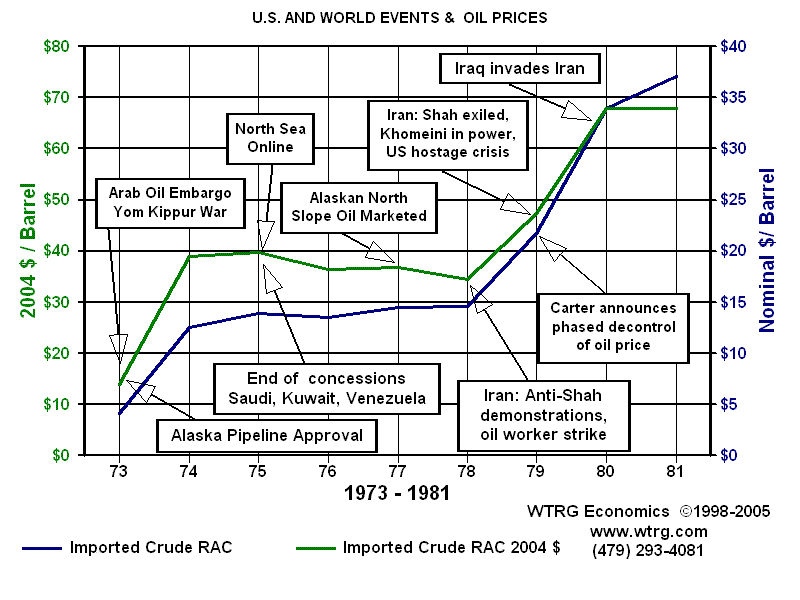
In 1972 the price of crude oil was about $3.00 per barrel and by the end of 1974 the price of oil had quadrupled to over $12.00. The Yom Kippur War started with an attack on Israel by Syria and Egypt on October 5, 1973. The United States and many countries in the western world showed support for Israel. As a result of this support several Arab exporting nations imposed an embargo on the countries supporting Israel. While Arab nations curtailed production by 5 million barrels per day (MMBPD) about 1 MMBPD was made up by increased production in other countries. The net loss of 4 MMBPD extended through March of 1974 and represented 7 percent of the free world production.

If there was any doubt that the ability to control crude oil prices had passed from the United States to OPEC it was removed during the Arab Oil Embargo. The extreme sensitivity of prices to supply shortages became all too apparent when prices increased 400 percent in six short months.

From 1974 to 1978 world crude oil prices were relatively flat ranging from $12.21 per barrel to $13.55 per barrel. When adjusted for inflation the price over that period of time world oil prices were in a period of moderate decline.

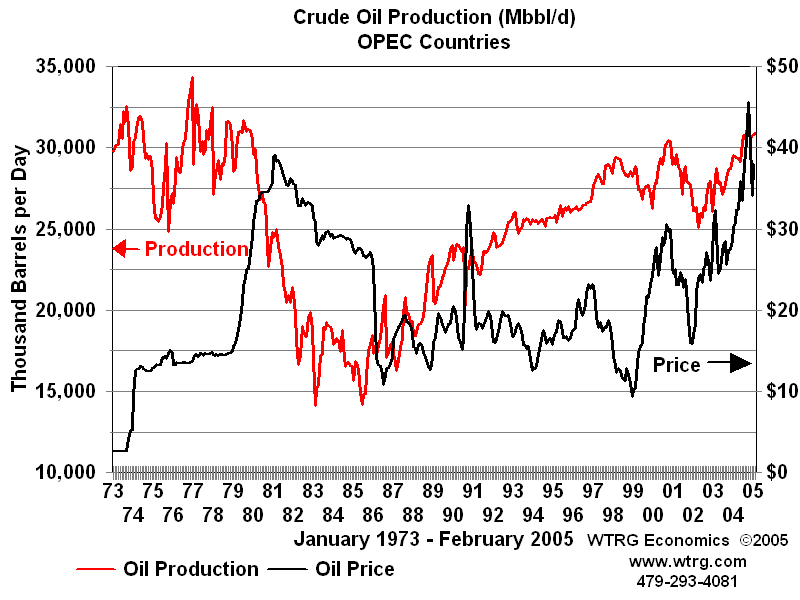
U.S. and World Events and Oil Prices 1973-1981 Click on graph for larger view OPEC Oil Production 1973-2007Click on graph for larger view
Crises in Iran and Iraq

Events in Iran and Iraq led to another round of crude oil price increases in 1979 and 1980. The Iranian revolution resulted in the loss of 2 to 2.5 million barrels per day of oil production between November, 1978 and June, 1979. At one point production almost halted.
While the Iranian revolution was the proximate cause of what would be the highest prices in post-WWII history, its impact on prices would have been limited and of relatively short duration had it not been for subsequent events. Shortly after the revolution production was up to 4 million barrels per day.

Iran weakened by the revolution was invaded by Iraq in September, 1980. By November the combined production of both countries was only a million barrels per day and 6.5 million barrels per day less than a year before. As a consequence worldwide crude oil production was 10 percent lower than in 1979.

The combination of the Iranian revolution and the Iraq-Iran War cause crude oil prices to more than double increasing from from $14 in 1978 to $35 per barrel in 1981.
Twenty-six years later Iran's production is only two-thirds of the level reached under the government of Reza Pahlavi, the former Shah of Iran.

Iraq's production remains about 1.5 million barrels below its peak before the Iraq-Iran War.
Iran Oil production 1973-2007

US Oil Price Controls - Bad Policy?

The rapid increase in crude prices from 1973 to 1981 would have been much less were it not for United States energy policy during the post Embargo period. The US imposed price controls on domestically produced oil in an attempt to lessen the impact of the 1973-74 price increase. The obvious result of the price controls was that U.S. consumers of crude oil paid about 50 percent more for imports than domestic production and U.S producers received less than world market price. In effect, the domestic petroleum industry was subsidizing the U.s. consumer.
Did the policy achieve its goal? In the short term, the recession induced by the 1973-1974 crude oil price rise was less because U.S. consumers faced lower prices than the rest of the world. However, it had other effects as well.

In the absence of price controls U.S. exploration and production would certainly have been significantly greater. Higher petroleum prices faced by consumers would have resulted in lower rates of consumption: automobiles would have had higher miles per gallon sooner, homes and commercial buildings would have been better insulated and improvements in industrial energy efficiency would have been greater than they were during this period. As a consequence, the United States would have been less dependent on imports in 1979-1980 and the price increase in response to Iranian and Iraqi supply interruptions would have been significantly less.


OPEC's Failure to Control Crude Oil Prices

OPEC has seldom been effective at controlling prices. While often referred to as a cartel, OPEC does not satisfy the definition. One of the primary requirements is a mechanism to enforce member quotas. The old joke went something like this. What is the difference between OPEC and the Texas Railroad Commission? OPEC doesn't have any Texas Rangers! The only enforcement mechanism that has ever existed in OPEC was Saudi spare capacity.With enough spare capacity at times to be able to increase production sufficiently to offset the impact of lower prices on its own revenue, Saudi Arabia could enforce discipline by threatening to increase production enough to crash prices. In reality even this was not an OPEC enforcement mechanism unless OPEC's goals coincided with those of Saudi Arabia.During the 1979-1980 period of rapidly increasing prices, Saudi Arabia's oil minister Ahmed Yamani repeatedly warned other members of OPEC that high prices would lead to a reduction in demand. His warnings fell on deaf ears.

Surging prices caused several reactions among consumers: better insulation in new homes, increased insulation in many older homes, more energy efficiency in industrial processes, and automobiles with higher efficiency. These factors along with a global recession caused a reduction in demand which led to falling crude prices. Unfortunately for OPEC only the global recession was temporary. Nobody rushed to remove insulation from their homes or to replace energy efficient plants and equipment -- much of the reaction to the oil price increase of the end of the decade was permanent and would never respond to lower prices with increased consumption of oil.

Higher prices also resulted in increased exploration and production outside of OPEC. From 1980 to 1986 non-OPEC production increased 10 million barrels per day. OPEC was faced with lower demand and higher supply from outside the organization.

From 1982 to 1985, OPEC attempted to set production quotas low enough to stabilize prices. These attempts met with repeated failure as various members of OPEC produced beyond their quotas. During most of this period Saudi Arabia acted as the swing producer cutting its production in an attempt to stem the free fall in prices. In August of 1985, the Saudis tired of this role. They linked their oil price to the spot market for crude and by early 1986 increased production from 2 MMBPD to 5 MMBPD. Crude oil prices plummeted below $10 per barrel by mid-1986. Despite the fall in prices Saudi revenue remained about the same with higher volumes compensating for lower prices.

A December 1986 OPEC price accord set to target $18 per barrel bit it was already breaking down by January of 1987and prices remained weak.

The price of crude oil spiked in 1990 with the lower production and uncertainty associated with the Iraqi invasion of Kuwait and the ensuing Gulf War. The world and particularly the Middle East had a much harsher view of Saddam Hussein invading Arab Kuwait than they did Persian Iran. The proximity to the world's largest oil producer helped to shape the reaction.
Following what became known as the Gulf War to liberate Kuwait crude oil prices entered a period of steady decline until in 1994 inflation adjusted prices attained their lowest level since 1973.

The price cycle then turned up. The United States economy was strong and the Asian Pacific region was booming. From 1990 to 1997 world oil consumption increased 6.2 million barrels per day. Asian consumption accounted for all but 300,000 barrels per day of that gain and contributed to a price recovery that extended into 1997. Declining Russian production contributed to the price recovery. Between 1990 and 1996 Russian production declined over 5 million barrels per day.

OPEC continued to have mixed success in controlling prices. There were mistakes in timing of quota changes as well as the usual problems in maintaining production discipline among its member countries.

The price increases came to a rapid end in 1997 and 1998 when the impact of the economic crisis in Asia was either ignored or severely underestimated by OPEC. In December, 1997 OPEC increased its quota by 2.5 million barrels per day (10 percent) to 27.5 MMBPD effective January 1, 1998. The rapid growth in Asian economies had come to a halt. In 1998 Asian Pacific oil consumption declined for the first time since 1982. The combination of lower consumption and higher OPEC production sent prices into a downward spiral. In response, OPEC cut quotas by 1.25 million b/d in April and another 1.335 million in July. Price continued down through December 1998.

Prices began to recover in early 1999 and OPEC reduced production another 1.719 million barrels in April. As usual not all of the quotas were observed but between early 1998 and the middle of 1999 OPEC production dropped by about 3 million barrels per day and was sufficient to move prices above $25 per barrel.

With minimal Y2K problems and growing US and world economies the price continued to rise throughout 2000 to a post 1981 high. Between April and October, 2000 three successive OPEC quota increases totaling 3.2 million barrels per day were not able to stem the price increases. Prices finally started down following another quota increase of 500,000 effective November 1, 2000.

Russian production increases dominated non-OPEC production growth from 2000 forward and was responsible for most of the non-OPEC increase since the turn of the century.

Once again it appeared that OPEC overshot the mark. In 2001, a weakened US economy and increases in non-OPEC production put downward pressure on prices. In response OPEC once again entered into a series of reductions in member quotas cutting 3.5 million barrels by September 1, 2001. In the absence of the September 11, 2001 terrorist attack this would have been sufficient to moderate or even reverse the trend.

In the wake of the attack crude oil prices plummeted. Spot prices for the U.S. benchmark West Texas Intermediate were down 35 percent by the middle of November. Under normal circumstances a drop in price of this magnitude would have resulted an another round of quota reductions but given the political climate OPEC delayed additional cuts until January 2002. It then reduced its quota by 1.5 million barrels per day and was joined by several non-OPEC producers including Russia who promised combined production cuts of an additional 462,500 barrels. This had the desired effect with oil prices moving into the $25 range by March, 2002. By mid-year the non-OPEC members were restoring their production cuts but prices continued to rise and U.S. inventories reached a 20-year low later in the year.

By year end oversupply was not a problem. Problems in Venezuela led to a strike at PDVSA causing Venezuelan production to plummet. In the wake of the strike Venezuela was never able to restore capacity to its previous level and is still about 900,000 barrels per day below its peak capacity of 3.5 million barrels per day. OPEC increased quotas by 2.8 million barrels per day in January and February, 2003.

On March 19, 2003, just as some Venezuelan production was beginning to return, military action commenced in Iraq. Meanwhile, inventories remained low in the U.S. and other OECD countries. With an improving economy U.S. demand was increasing and Asian demand for crude oil was growing at a rapid pace.

The loss of production capacity in Iraq and Venezuela combined with increased OPEC production to meet growing international demand led to the erosion of excess oil production capacity. In mid 2002, there was over 6 million barrels per day of excess production capacity and by mid-2003 the excess was below 2 million. During much of 2004 and 2005 the spare capacity to produce oil was under a million barrels per day. A million barrels per day is not enough spare capacity to cover an interruption of supply from most OPEC producers.

In a world that consumes over 80 million barrels per day of petroleum products that added a significant risk premium to crude oil price and is largely responsible for prices in excess of $40-$50 per barrel.

Other major factors contributing to the current level of prices include a weak dollar and the continued rapid growth in Asian economies and their petroleum consumption. The 2005 hurricanes and U.S. refinery problems associated with the conversion from MTBE as an additive to ethanol have contributed to higher prices.

One of the most important factors supporting a high price is the level of petroleum inventories in the U.S. and other consuming countries. Until spare capacity became an issue inventory levels provided an excellent tool for short-term price forecasts. Although not well publicized OPEC has for several years depended on a policy that amounts to world inventory management. Its primary reason for cutting back on production in November, 2006 and again in February, 2007 was concern about growing OECD inventories. Their focus is on total petroleum inventories including crude oil and petroleum products, which are a better indicator of prices that oil inventories alone

posted by :darren

Some videos


Food inflation in China

Several shocking facts about the world's most power economies

Oil prices

Why global oil prices are rising?

Oil is a major source of energy the world over. When energy (read oil) is available at low prices, the outlook towards growth is optimistic and vice versa. Crude oil prices have been rising continuously since 1998, when the price was $10 a barrel.

Since the death of the King Fahd of Saudi Arabia on August 3, crude oil prices have crossed $60 a barrel. Recently, crude prices crossed $70 a barrel as the hurricane Katrina hit the United States and brought production in the Gulf of Mexico to a halt.

All this has led to talk of sustained high prices in the days to come. But, as history tells us, oil is a cyclical business: prices go up only to come down again. So the question that needs to be asked is: why have oil prices been going up and will this increase continue in the days to come?

There are several reasons to account for the rising oil prices.

The oil cartel

Since the mid-eighties, the Organisation of Petroleum Exporting Countries (OPEC) has been acting as a swing oil producer of the world. That is, OPEC produces only to fill the gap between global oil demand and production by non-OPEC countries.

Over the years, the swing production arrangement resulted in OPEC having a lot of idle capacity. This helped OPEC to gain control over oil prices. Whenever the inventory level of oil stocks in industrialised nations, particularly the members of Organization of Economic Cooperation and Development (OECD) went up, OPEC reduced output.

This artificial scarcity that OPEC manages to create did not allow oil prices to fall.

The same idle capacity has been used to pump extra oil into the market to prevent dramatic price rises during times of unexpected supply interventions. Most of this idle capacity is in Saudi Arabia, the largest member within OPEC.

The country has effectively used its idle capacity in the past to prevent any price increase during the Iran-Iraq war, the Gulf War and the recent Venezuelan crisis.

But that situation seems to be changing now, with OPEC unable to control the surging global oil prices. OPEC members have been pumping oil as fast as they can with hardly any idle capacity left. Saudi Arabia is the only country that has some spare capacity left. The idle capacity stands at just 0.5 million barrels per day (mbpd) as against 3 mbpd few years back.

So even though there is no shortage of crude oil, the fact that there is no safety net, has made the oil traders jittery. This has led to them demanding a risk premium and so the high price.

There are also other reasons which include political instability in the oil-rich countries for example, the middle-east countries, as well as the increased global demand over the recent years. Global consumption of oil went up by 3.4% last year. The consumption of oil in the United States remains the biggest reason for this sustained growth in the global oil demand. The US, which has just 5% of the world population, consumes one quarter of the global produce. The oil efficiency of vehicles in the US has now fallen to a 20-year low. Its energy policy does very little to ensure greater fuel economy in cars or sports utility vehicles.

-Yiming

Saturday, May 17, 2008

econocomics! :))

this is a comic about tax cuts but i cant post it over here coz of copyright issues so this is the link..

more comics about tax cuts..

<3, elissa

Market for Lemons

Information transmission

An archetypical lemons market existed in India in the 1970s (Klitgaard, 1991).
Quality fresh milk was hard to find, because vendors routinely watered it down. Buyers
could not assess the milk’s butterfat content, and so the low-quality milk drove out the
high-quality milk. Launching a campaign against adulterated milk, the National Dairy
Development Board provided inexpensive machines to measure butterfat content as the
milk moved from farmer to wholesaler to vendor. It also set up payment schemes making
the price of milk reflect its measured quality and created brand names to give buyers trust
in what they were getting. As a result of this coordinated initiative, quality improved and
consumption rose.

The loan market is impeded by information asymmetries: both adverse
selection—a lender may find it hard to distinguish whether any given loan applicant is a
good credit risk—and moral hazard—a borrower, having received a loan, may have an
incentive to default. Since these transaction costs are proportionately larger for small
than for large loans, small lenders often pay exorbitant interest rates or are frozen out of
the loan market. In Bangladesh’s Grameen Bank and other microcredit banks, tiny loans
are made to poor people via groups of borrowers. Each group member is held
responsible for any other member’s loan. Being neighbours, the group members know
each other’s business better than any banker, can monitor each other’s use of the loans
and can invoke social sanctions to discipline defaulters. Group lending is an elegant
solution to the loan market’s informational asymmetries.

The equity market relies heavily on institutions. For shareholders, who lack
information about the firm’s affairs, evaluating managers is difficult, and so a lemons
market may arise. In many countries, lax oversights allow controlling shareholders to
expropriate minority shareholders (Johnson et al., 2000). If the rules governing the
financial markets are inadequate, investors are reluctant to buy stocks because they are
unwilling to trust managers, and so firms do not get the finance they need. A well functioning equity market relies on a complex set of interrelated institutions, formal and informal, to foster information flow (Black, 2001). First, reputations for honest dealings must be built up by auditors, law firms, investment banks and the business press.

Second, there are self-regulating private-sector bodies such as industry associations as
well as the stock exchange, with its rules on listing firms’ financial reporting and its
sanction of delisting. Third, the equity market rests on state-provided mechanisms: not
only laws requiring that investors receive accurate data, but also an activist regulator.
The law’s transaction costs (Glaeser and Shleifer, 2003) mean that a regulator
supplements the courts in setting and enforcing the rules of the game.

Comments

I got this article from http://faculty-gsb.stanford.edu/mcmillan/personal_page/documents/Market%20Institutions.pdf. There is more but i just picked out the section that i think is more interesting so if you wanna read can go there n see :) Basically, this example uses the concept of information asymmetry, which occurs when the seller knows more about a product than the buyer. This concept is found in "The Market for Lemons: Quality Uncertainty and the Market Mechanism", which is a 1970 paper by the economist George Akerlof. It describes how the interaction between quality heterogeneity and asymmetrical information can lead to the disappearance of a market where guarantees are indefinite.

Suxiang

Thursday, May 15, 2008

Food for Thought

Hi. Instead of articles, I bring to you people some ekonzz entries posted on the most popular ekonzz blogz.

From http://freakonomics.blogs.nytimes.com/
The Rich Drink Better Beer, Not More
By Daniel Hamermesh


The average item bought by the average buyer has an income elasticity of nearly one: most people roughly double their spending when their income doubles. But everything we buy consists of both a quantity dimension and a quality dimension.
What’s clear is that the income elasticity of demand for quantity is less than one: when our income doubles, we don’t double the number of cars we buy, the number of beers we drink in a day, or the number of houses we own.
The income elasticity of demand for quality must therefore be more than one: as our incomes rise, we increase the quality of what we consume. We shift from Honda Civics to Lexuses (Lexi?), Budweiser to Belgian dobbels, prefab houses to mini-mansions.
The reason is simple: it takes time to consume quantities, while the consumption of high-quality goods takes no more time than low-quality goods; and as we get richer we have no more time — we all face 24 hours in the day.
With incomes rising over time, businesses are smart to bet on the demand for quality rising — and to enter markets where the payoff is to quality not quantity.

Review 1:

This entry is related to lecture series 4-7 on supply and demand since it is based on income elasticity of demand. It is short on quantity but high on quality, as it explains why income elasticity of quality demanded > 1 and why income elasticity of quantity demanded < 1 as income increases due in part to the indivisibility of goods. We simply can't logically own 2 Lexuses instead of 1 even if our income doubles.
However this is also not always true as quantity can still increase by a ratio of 1 or more such as in the case of golf played, vacations taken per year, number of computers owned etc. But this is also obviously outside of the context of the writer as he is linking the income elasticity of quality demanded back to how intelligent businesses would bet on quality demanded to rise to gain maximum profit.
But after all this is down to opinion and we cannot assume perfect competition for all cases. For example, people might not necessarily want to increase the quality or quantity of their goods simply because they have raised income levels. Furthermore the context the writer is discussing in is based increasing incomes over time in MEDCs, which has not necessarily been the case if one observes inflation levels over the past years.


Because, Not In Spite Of
By Daniel Hamermesh


A recent article notes that attendance in Major League Baseball parks is actually above last year, despite, so the story says, the economic downturn (recession?).
But despite is incorrect — it should be “because” of the economic downturn. The story notes that cheap seats at the Dodgers Stadium go for $8 to $13. Not bad for three plus hours of entertainment; but in good times who can afford that time?
In bad times, when the opportunity cost of time is reduced, the total price of an afternoon at the ballpark is lower for many people than it is when jobs are more plentiful. I see this in my own planning. Though I like baseball, I haven’t been to an M.L.B. game in over five years — I’ve been working too hard; but I do plan to attend more once I partially retire and the opportunity cost of my time drops.
Baseball watching is a time-intensive activity; and when time becomes “cheaper” for many people, as it does in a recession, it’s not surprising that the demand for watching M.L.B. games rises. The price of the complementary good to the ticket price — the price of one’s time — has fallen.

Review 2:
This is another intelligent entry on the blog based on an economic perspective of how cheap baseball tickets constitute the next best alternative for those American feeling the 'crunch', now they can no longer proudly afford the previous luxurious pastimes they used to engage in.
Perhaps the increase in ticket sales could also be due to the increase in focus on the commercialisation of baseball teams, such that the locals would be more than inclined to support their teams despite the downturn. This could also be down to the herd factor which causes more and more followers of local baseball teams.
For lack of a better explanation Americans could perhaps be searching for some form of emotional relief or support for the massive amounts of increased stress they go through in these bad times.
Yet down to its roots it is still the cheap ticket prices that are driving up ticket sales.

When blended with politics, like on http://robertreich.blogspot.com/
Hillary Clinton Doesn't Listen to Economists


When asked this morning by ABC News' George Stephanopoulos if she could name a single economist who backs her call for a gas tax holiday this summer, HRC said "I'm not going to put my lot in with economists.”

I know several of the economists who have been advising Senator Clinton, so I phoned them right after I heard this. I reached two of them. One hadn’t heard her remark and said he couldn’t believe she’d say it. The other had heard it and shrugged it off as “politics as usual.”

That’s the problem: Politics as usual.

The gas tax holiday is small potatoes relative to everything else. But it’s so economically stupid (it would increase demand for gas and cause prices to rise, eliminating any benefit to consumers while costing the Treasury more than $9 billion, and generate more pollution) and silly (even if she won, HRC won’t be president this summer) as to be worrisome. That HRC now says she doesn’t care that what economists think is even more troubling.

In case you’ve missed it, we now have a president who doesn’t care what most economists think. George W. Bush doesn’t even care what scientists think. He rejects all experts who disagree with his politics. This has led to some extraordinarily stupid policies.

I’m not saying HRC is George Bush. And I'm not suggesting economists have all the answers. But when economists tell a president or a presidential candidate that his or her idea is dumb – and when all respectable economists around America agree that it’s a dumb idea – it’s probably wise for the president or presidential candidate to listen. When the president or candidate doesn’t, and proudly defends the policy by saying she's "not going to put my lot in with economists,” we’ve got a problem, folks.

Even though the summer gas tax holiday is pure hokum, it polls well, which is why HRC and John McCain are pushing it. That Barack Obama is not in favor of it despite its positive polling numbers speaks volumes about the kind of president he’ll be – and the kind of president we’d otherwise get from McCain and HRC.

Haven’t we had enough of politicians who reject facts in favor of short-term poll-driven politics?

Review 3:
Disclaimer: extremely anti-Clinton

While HRD (Hillary Rodham Clinton) continues on her increasingly pestilent (to me) campaign, continuing to compromise the chances of a democrat majority come the faceoff, and despite it being unenviable that she has to continue receiving similar critiques of her words by critics, it is undeniable that this critic is right to voice his case.
The writer cleverly uses the collective intellectual 'authority' economists would naturally have to criticise the political strategy of Clinton to go on with the proposed gas tax holiday despite its obvious flaws of the law in the long run, simply because it polls well. He goes on to use this line of argument to highlight how Obama is a leader who leads based on logical facts and not on popularity.
If you have been following politics, you would note this interesting fact.
The reason why George Bush is hated so much is because Americans are not as foolish as they are thought to be by their leaders. A functioning government is wanted, and while responsible governance was part of her promises and she posed as a saviour of all things American. But now that her time is almost up (finally), she is promising what is impossible and lining herself with 'them evil oil companies'.
Are we for old hardball politics or for real change that would really evolve the society? Definitely the latter.


I won't spend too long speaking to you academics as I know most of you are here to listen to yourselves speak.
~ Wee Keat

Wednesday, May 14, 2008

heyy this is an interesting article i found online and it is a piece of recent news with regards to price discrimination, which is relevant to the last few lectures so i thought i should share it with the class..

IF ANYTHING was clear from the grocery inquiry's colourful hearing, it was that Australian Competition and Consumer Commission chairman Graeme Samuel wasn't going to let the head of the independent grocers association John Cummings off easily.

Mr Cummings, chairman of the National Association of Retail Grocers of Australia, took a swipe last month at Mr Samuel and effectively accused the consumer watchdog of neglecting its duties because, among other things, it had not reduced Woolworths' and Coles' majority share of the grocery market.

Mr Samuel responded that people with "vested interests" would face "rigorous examination" and have their claims tested during the inquiry. And so they have.

Mr Cummings' main proposition to the inquiry in Canberra yesterday was that because the two big chains have 80% of the market — although the exact level of market share is still being debated — they can set prices as high or low as they want and rip off consumers.

He said prices for basic items were usually higher in areas without independent retailers, and that there was price discrimination on milk. "I cannot buy milk at the same price as Coles and Woolworths do," he said. The association wants the Government to strengthen the Trade Practices Act to prevent Coles and Woolworths from buying out smaller supermarkets, end price discrimination, and ensure more transparency in the supply chain.

Mr Cummings, who owns three independent supermarkets in Perth, told the inquiry that about 40% of his business wasn't profitable. After compelling him to answer some uncomfortable questions, Mr Samuel asked why the association did not pressure Metcash, the main supplier for independent IGA stores across Australia, to lower prices. Mr Cummings said that was not the association's role.

The inquiry continues.

THANKS for being so enthusiastic in participating in the econs blog...=0 and perhaps u all can try posting some articles as well?

junxin

Videos

We will start with the useful.
Price Discrimination


More useful videos by the same person on
http://www.youtube.com/profile_videos?user=pajholden&p=r

Do you actually need to understand what you are trying to explain? This economist is honestly truthful about his limitations


Promotional Video for Mitt Romney, with focus on McCain's mistakes


This made me laugh out really loud even though I think I saw it before a few years back, perhaps now that I am an economics student I can truly understand why people would seriously scoff at this.


~Wee Keat

econs-related articles!

hello!
here's some articles related to econs...might help w data response/case study!((:

SingTel net income for fourth quarter rises 11%

French inflation eases slightly in April

Oil prices drop ahead of US energy data

'tiffany
Jokes. (Can't find anything else..)

Three economists and three mathematicians were going for a trip by train. Before the journey, the mathematicians bought 3 tickets but economists only bought one. The mathematicians were glad their stupid colleagues were going to pay a fine. However, when the conductor was approaching their compartment, all three economists went to the nearest toilet. The conductor, noticing that somebody was in the toilet, knocked on the door. In reply he saw a hand with one ticket. He checked it and the economists saved 2/3 of the ticket price.
The next day, the mathematicians decided to use the same strategy- they bought only one ticket, but economists did not buy tickets at all! When the mathematicians saw the conductor, they hid in the toilet, and when they heard knocking they handed in the ticket. They did not get it back.
Why? The economists took it and went to the other toilet.

Q. What does an economist do?

A. A lot in the short run, which amounts to nothing in the long run.

(Erm if you don't understand, you might have to refer to your cost theory notes! XD Which is what I am doing.)

References : www.nd.edu/~jstiver/jokes.htm
www.richardpettinger.com/economics/funny_economic

Natalie!

Comics

Hey. Some comics courtesy of http://elzr.com/images/blog/comics/adolfo.png and http://www.ocee.org/comics.htm Is the awakened dragon is dragging down U.S. stocks?
Circular excuse/argument on deficit cuts requires increased taxes; tax cuts require deficit reductions; spending cuts requires less programs; congress has no time, having to constantly work on cutting deficits = Hinting how useless and full of excuses congress is.
Simply, the government intervention which aims to solve problems is the cause of the problems.
Old comic on how futile George Bush's efforts are, conceited or not.
Stock market dragged down by the 2007 mortgage crisis, even up till now
the Euro owns the Dollar with a simple foot-kick. Ownzed in Ekonz Yowzazz


Pun on excuse manufacturing literally and metaphorically - American automakers continue to automatically manufacture excuses.

If time is going to pass anyway, why do you say you are wasting your time doing this/that/nothing productive?

~Wee Keat

Jokes

Courtesy of http://www.jokes.net/
Q: Why do social workers refuse to sleep with economists?
A: They have learned it’s a sunk cost.
Q: What does it take to be a good economist?
A: An unshakeable grasp of the obvious!
Q: How has French revolution affected world economic growth?
A: Too early to say.
Q: How many conservative economists does it take to change a light bulb?
A: None; they're all waiting for the unseen hand of the market to correct the lighting disequilibrium.
Q: How many investors does it take to change a light bulb?
A: None - the market has already discounted the change.
Q: Why is advice so cheap?A: Because supply always exceeds demand.
Q: Why did God create economists?A: In order to make weather forecasters look good.


Short Jokes
Three econometricians went out hunting, and came across a large deer. The first econometrician fired, but missed, by a meter to the left. The second econometrician fired, but also missed, by a meter to the right. The third econometrician didn't fire, but shouted in triumph, "We got it! We got it!"

A civil engineer, a chemist and an economist are traveling in the countryside. Weary, they stop at a small country inn. "I only have two rooms, so one of you will have to sleep in the barn," the innkeeper says. The civil engineer volunteers to sleep in the barn, goes outside, and the others go to bed. In a short time they're awakened by a knock. It's the engineer, who says, "There's a cow in that barn. I'm a Hindu, and it would offend my beliefs to sleep next to a sacred animal." The chemist says that, OK, he'll sleep in the barn. The others go back to bed, but soon are awakened by another knock. It's the chemist who says, "There's a pig in that barn. I'm Jewish, and cannot sleep next to an unclean animal." So the economist is sent to the barn. It's getting late, the others are very tired and soon fall asleep. But they're awakened by an even louder knocking. They open the door and are surprised by what they see: It's the cow and the pig!

A woman hears from her doctor that she has only half a year to live. The doctor advises her to marry an economist and to live in South Dakota. The woman asks: will this cure my illness? Answer of the doctor: No, but the half year will seem pretty long.

Bill and Boris
Bill and Boris are taking a break from a long summit, Boris says to Bill, -Bill, you know, I have a big problem I don't know what to do about. I have a hundred bodyguards and one of them is a traitor. I don't know which one. -Not a big deal Boris, I'm stuck with a hundred economists I have to listen to all the time before any policy decision, and only one tells the truth but it's never the same one.

Cannibals and Economists
A traveller wandering on an island inhabited entirely by cannibals comes upon a butcher shop. This shop specialised in human brains differentiated according to source. The sign in the shop read:
Artists' Brains $9/lb Philosophers' Brains $12/lb Scientists' Brains $15/lb Economists' Brains $19/lb
Upon reading the sign, the traveller noted, "My those economists' brains must be popular!" To which the butcher replied, "Are you kidding! Do you have any idea how many economists you have to kill to get a pound of brains?!"

Frog Princess
A boy was crossing a road one day when a frog called out to him and said, "If you kiss me, I'll turn into a beautiful princess." He bent over, picked up the frog and put it in his pocket. The frog spoke up again and said, "If you kiss me and turn me back into a beautiful princess, I will stay with you for one week." The boy took the frog out of his pocket, smiled at it, and returned it to his pocket. The frog then cried out, "If you kiss me and turn me back into a princess, I'll stay with you and do ANYTHING you want." Again the boy took the frog out, smiled at it and put it back into his pocket. Finally, the frog asked, "What is the matter? I've told you I'm a beautiful princess, that I'll stay with you for a week and do anything you want. Why won't you kiss me?" The boy said, "Look, I'm an economist. I don't have time for a girlfriend, but a talking frog is cool."

TOP 10 REASONS TO STUDY ECONOMICS
1. Economists are armed and dangerous:"Watch out for our invisible hands."
2. Economists can supply it on demand.
3. You can talk about money without every having to make any.
4. You get to say "trickle down" with a straight face.
5. Mick Jagger and Arnold Schwarzenegger both studied economics and look how they turned out.
6. When you are in the unemployment line, at least you will know why you are there.
7. If you rearrange the letters in "ECONOMICS", you get "COMIC NOSE".
8. Although ethics teaches that virtue is its own reward, in economics we get taught that reward is its own virtue.
9. When you get drunk, you can tell everyone that you are just researching the law of diminishing marginal utility.
10. When you call 1-900-LUV-ECON and get Kandi Keynes, you will have something to talk about.

An economist is someone who doesn't know what he's talking about - and makes you feel it's your fault.
~ Wee Keat